
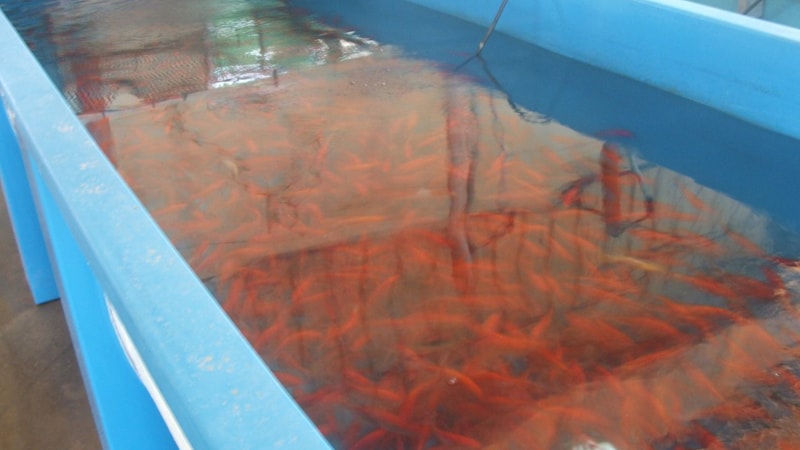
Turnkey fish hatcheries and intensive fish-farming facilities enable commercial aquaculture producers to achieve predictable, year-round yields with minimal water consumption by tightly controlling dissolved oxygen, nitrogenous waste removal, temperature, and pathogen loads inside engineered land-based environments.
Below, we outline our end-to-end engineering capabilities, core water-treatment and life-support technologies, critical hydraulic and species-specific design parameters, operational advantages, and answers to key technical questions for building or upgrading high-density aquaculture infrastructure.
Fish Hatcheries & Intensive Fish Farming Facilities
We design, produce and install fish hatcheries and intensive fish-farming facilities, both in Israel and globally.
Our deep sector knowledge and hands-on experience allow us to deliver turnkey solutions that meet both operational and environmental standards in aquaculture. By combining precision polymer and composite tank fabrication with closed-loop hydraulic engineering, we bridge the gap between biological fish welfare and industrial-scale production efficiency—supporting both freshwater and marine/brackish aquaculture operations.
What We Offer
- Comprehensive Planning & Design: From site assessment through final commissioning, we cover fish species requirements, growth cycles, stocking densities, biosecurity, water quality, energy efficiency, and regulatory compliance. This includes mass-balance calculations for feed input versus ammonia and solids generation to ensure zero undersized bottlenecks at peak biomass.
- Fish Ponds and Tanks: We supply a variety of pond and tank types (e.g. concrete, fiberglass, plastic, or composite) sized appropriately for hatchery (egg and fry), fingerling, and grow-out stages. Custom geometries—such as circular dual-drain tanks and self-cleaning raceways—are engineered with smooth, non-toxic, easy-to-sanitize interior surfaces that minimize fin abrasion and biofilm harborages.
- Water Treatment Systems: Including bio-filter systems for removal of toxic nitrogenous compounds, mechanical filters for solids removal, and clarifiers or sumps for sedimentation. We integrate rotary micro-screen drum filters, radial-flow settlers, and high-surface-area Moving Bed Biofilm Reactors (MBBR) or trickling filters tailored to the facility’s hydraulic retention time.
- Disinfection & Sterilization: UV systems and ozone equipment to reduce microbial loads, inactivate pathogens, and maintain water quality. These systems are chemical-free or minimally chemical-dependent and help prevent disease outbreaks, with carefully calibrated Oxidation-Reduction Potential (ORP) controls and residual ozone stripping to protect sensitive gill tissue.
- Aeration and Oxygenation: Pumps, diffusers, or pure oxygen solutions to keep dissolved oxygen at optimal levels, especially critical in high-density operations. High-efficiency Low-Head Oxygenators (LHO), oxygen cones, and fine-bubble diffusers maximize gas-transfer efficiency while reducing kWh per kilogram of fish produced.
- Auxiliary Systems: Including water inlets/outlets, waste removal, degassing (CO₂), pH control, temperature regulation (heat exchangers or chillers), and environmental sensors for monitoring water parameters. Stripping dissolved carbon dioxide via packed-column degassers is specifically engineered alongside oxygenation to prevent nephrocalcinosis and maintain blood-oxygen transport efficiency.
Key Components & Technologies
| Component | Function | Importance to Intensive Fish Farming |
|---|---|---|
| Mechanical Filters | Remove solid waste and suspended particles before water enters biological systems. | Prevent clogging, reduce load on biofilters, maintain water clarity. |
| Bio-filters / Biological Filtration | Nitrification, conversion of ammonia → nitrite → nitrate via beneficial microbes. | Essential for maintaining safe ammonia and nitrite levels, enabling high stocking densities. |
| UV Systems | Disinfection of water by inactivating pathogens, bacteria, viruses, parasites. | Helps ensure health of fish stocks; often used after filtration. |
| Ozone Systems | Oxidation of organic materials, color removal, disinfection, reducing dissolved organic compounds. | Enhances water quality, complements UV treatment, can improve growth and reduce mortality. |
| Aeration / Oxygenation | Maintaining sufficient dissolved oxygen; mixing water to avoid dead zones. | Critical for fish metabolism, especially in warm water or high density conditions. |
Design Considerations
- Species-specific Requirements: Different species (trout, tilapia, carp, etc.) have different requirements for temperature, oxygen, pH, water quality, and space. We also engineer specialized configurations for sensitive early life stages—such as vertical incubation trays, upwelling jars for pelagic or demersal eggs, and gentle laminar-flow nursery troughs for first-feeding larvae.
- Recirculating Aquaculture Systems (RAS): For intensive operations, RAS allows water reuse, reduced water consumption, and better environmental control (waste, temperature, pathogens). Properly engineered RAS loops recycle 90% to 99% of process water daily, isolating the stock from external waterborne parasites, seasonal temperature swings, and agricultural runoff.
- Flow Rates, Turnover, and Water Exchange: Proper sizing of pumps, pipes, and filters is crucial to maintain the flow and exchange rates needed to flush waste and maintain oxygen levels without stressing the fish. Dual-drain tank hydrodynamics separate heavy settleable solids via a center bottom drain while drawing cleaner suspended water from a side wall outlet, accelerating solids capture before fecal pellets break down into dissolved ammonia.
- Modularity and Scalability: Facilities should be scalable (adding tanks or modules) and modular to allow maintenance, separation of growth stages (fry, fingerling, grow-out), and disease containment. Designing independent hydraulic loops per production cohort enables “all-in, all-out” biosecurity protocols and full dry-out disinfection between batches without halting the rest of the farm.
- Monitoring and Automation: Water quality sensors (for dissolved oxygen, ammonia, nitrates, pH, temperature), alarm systems, automated dosing (e.g. for pH or disinfection), and control systems help ensure stable operation and fast response to anomalies. Integrated PLC/SCADA telemetry paired with automatic fail-safe oxygen backup manifolds protects high-value biomass against power outages or pump faults within seconds.
Real-World Applications & Facility Types
Every aquaculture operation faces distinct biological, climatic, and regulatory constraints. Our engineering solutions are tailored across multiple production models:
- Commercial Seed & Fingerling Hatcheries: Biosecure broodstock conditioning rooms, egg incubation units, and high-survival nursery modules designed to supply robust, pathogen-free fingerlings to external cage farms or grow-out facilities.
- Land-Based Intensive Grow-Out Farms (RAS & Hybrid Flow-Through): High-density production units engineered for regions with limited freshwater availability, strict effluent discharge regulations, or extreme ambient temperatures.
- Quarantine & Acclimation Stations: Isolated multi-tank holding systems equipped with dedicated UV/ozone loops and thermal ramping controls for safely introducing imported stock or transitioning euryhaline species between freshwater and seawater.
- Research, R&D & Selective Breeding Centers: Replicated multi-tank experimental arrays with independent parameter logging and precision flow control for universities, feed trials, and genetic selection programs.
Benefits of Our Approach
– Improved survival rates and growth performance by maintaining optimal environment.
– Lower operational risks due to disease control (via UV/ozone/disinfection).
– Reduced water usage (especially with RAS) and better environmental compliance.
– More predictable production cycles and better quality fish.
– Turnkey installations from us minimize customer’s project management burden.
Frequently Asked Questions (FAQ)
- What is the difference between a flow-through system and a Recirculating Aquaculture System (RAS)?
In a flow-through system, water passes through the fish tanks once before being discharged or lightly treated, requiring a large, continuous supply of clean source water. In an intensive RAS facility, 90% to 99% of the water is continuously filtered, bio-processed, degassed, oxygenated, and sterilized for reuse—dramatically lowering water consumption and giving operators complete control over temperature and biosecurity. - How is biofilter capacity sized for an intensive fish hatchery or grow-out facility?
Biofilter sizing is calculated based on peak daily feed input (in kilograms per day) and the protein content of the feed, rather than tank volume alone. Engineers determine the maximum Total Ammonia Nitrogen (TAN) excretion rate at peak biomass and provide sufficient specific surface area (m²/m³) in the biological media to ensure complete nitrification at the target operating temperature. - Why is CO₂ degassing essential in high-density fish farming even when pure oxygen is used?
While pure oxygen systems allow higher stocking densities, fish respiration and biofilter bacteria continuously produce dissolved carbon dioxide. If CO₂ accumulates above species-specific thresholds (often 15–20 mg/L), it reduces the oxygen-carrying capacity of fish blood (the Bohr effect), lowers water pH, and causes chronic stress or nephrocalcinosis—making packed-column degassing towers vital. - Which tank materials are best suited for fish hatcheries and intensive farming?
Fiberglass Reinforced Plastic (FRP), high-density polyethylene (HDPE), polypropylene (PP), and coated concrete are the industry standards. Polymer and fiberglass tanks are especially favored in hatcheries and modular RAS units due to their smooth non-porous walls, rapid installation, corrosion resistance in saltwater, and ease of modification for dual-drain plumbing. - How do UV and ozone work together in aquaculture water treatment?
Ozone is a powerful oxidizer that breaks down fine dissolved organic compounds, removes water yellowing (humic substances), and improves water clarity, which in turn increases UV transmittance (UVT). Placing ozone treatment ahead of UV irradiation allows the UV system to inactivate bacteria, viruses, and parasites with far greater efficiency. - How do intensive facilities prevent catastrophic fish loss during a power or pump failure?
Because high-density tanks can deplete dissolved oxygen within minutes if circulation stops, properly engineered facilities incorporate redundant duty/standby pumps, automatic backup generators, and fail-safe solenoid valves that release emergency bottled or liquid oxygen directly into tank diffusers upon power loss or low-DO sensor alarms. - Can an intensive fish farm or hatchery be built in phases to manage capital expenditure?
Yes. By designing a modular facility layout with independent hydraulic loops for nursery, pre-grow-out, and grow-out cohorts, operators can commission an initial core production module and seamlessly add parallel tank modules and filtration skids as market demand and cash flow grow. - How are solid wastes managed and discharged in modern land-based aquaculture facilities?
Dual-drain tank hydraulics and rotary drum filters concentrate uneaten feed and fecal solids into a small backwash stream (typically less than 1% to 2% of total system flow). This concentrated sludge can be routed to thickening cones, geotextile dewatering bags, or biodigesters for environmentally compliant disposal or agricultural fertilizer reuse.


Idan B Plastics Ltd., a member of the Belsky Group
 יוסף בצרי 45, קרית אתא


